
GODA PALEKAITĖ
IUNO is pleased to announce the residency of Goda Palekaitė, artist, writer, and researcher, and to host her new research project.
Part of the Lithuanian Culture in Italy 2025–2026 program, implemented by theLithuanian Culture Institute and theEmbassy of the Republic of Lithuania in the Italian Republic, and in collaboration with the German Academy Rome Villa Massimo and the Akademie der Künste Berlin (ADK) within the framework of the Songs of Serpents residency program at Villa Serpentara in Olevano Romano, the artist’s research project draws inspiration from a historical period that resonates with the present: the 3rd–5th centuries AD.
It is during these centuries that social reality takes on the features of an apocalyptic scenario: the religious, cultural, legal, and urban order of the Roman Empire disintegrates, and its ideals are overturned. In this context, in the capital of the Empire, spaces known as “catacombs” take shape: underground burial sites outside the city walls, networks of corridors that become places of refuge and worship for early Christian communities, where the dead were buried, rites practiced, martyrs venerated, and a new visual imagination emerged, rich in transitional iconographies and unprecedented symbolic systems.
Goda Palekaitė’s project approaches the catacombs as metaphorical, political, ideological, and geological sites in which the foundations of the culture that has shaped Europe from that time to the present come to the surface. Although inspired by a historical period and driven by the desire to interweave different disciplines, the project is first and foremost an artistic investigation guided by speculative imagination, a defining feature of Palekaitė’s poetic practice.
The question the artist poses is: how can today’s geopolitical, economic, and ecological apocalypse be understood through a historical allegory? If the declining contemporary Western world order can be compared to that of the ancient Romans, what emerges from the catacombs when viewed through the lens of the present?
In speculative and intuitive terms, today’s “catacombs” may possess very different materialities and voices. Yet we still lack sufficient conceptual tools to understand and confront the current paradigm shift without panic, paralysis, or techno-capitalist ambition. Only artistic research seems capable of contributing to the development of the imagination and critical discourse necessary to envision possible future scenarios.
Bringing together fieldwork, historical research, creative writing, video, performance, linguistics, and artificial intelligence, during her residency at IUNO, Goda Bringing together fieldwork, historical research, creative writing, video, performance, linguistics, and artificial intelligence, during her residency at IUNO Goda Palekaitė will explore this potential in both artistic and academic contexts, using the methods of each to develop a comprehensive body of work to be presented in Rome in spring 2027.
Image Credits:
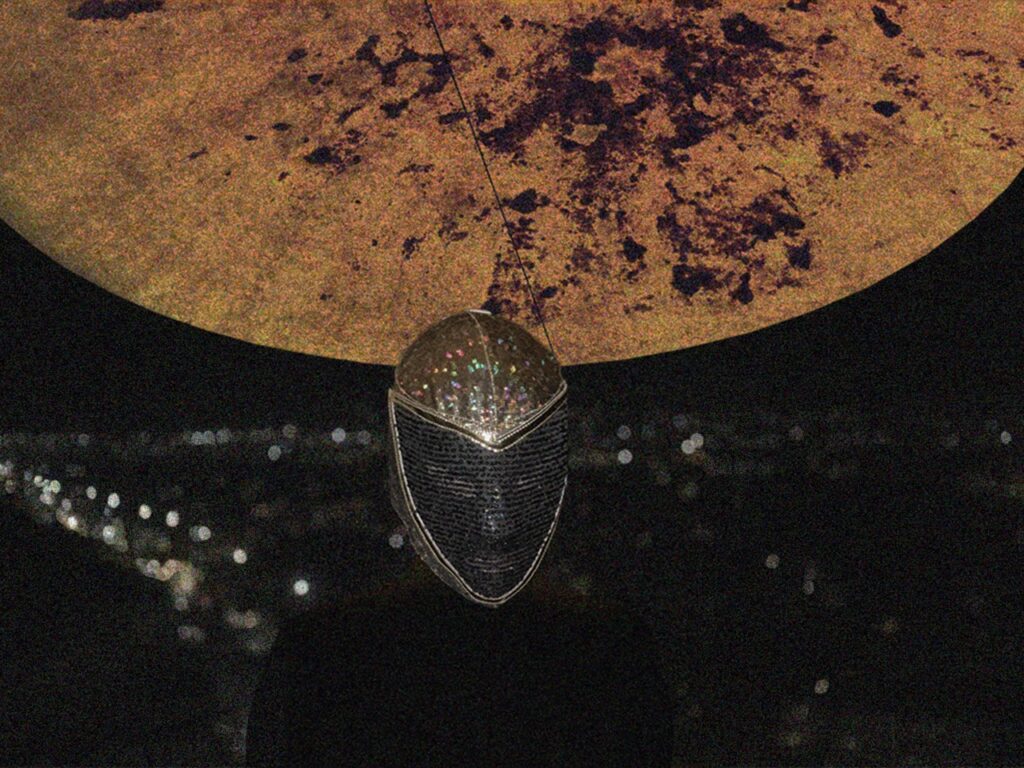
Goda Palekaitė, performance Lunar Sisterhood, National Gallery of Arts, Vilnius, 2025.
Goda Palekaitė is a Brussel-based Lithuanian artist, writer and researcher working in the intersection of contemporary art, performance, artistic research, literature, and anthropology. Her practice evolves around projects and programmes exploring the politics of historical narratives, the agency of dreams and fiction, and the alternative discourses of knowledge. Goda’s solo shows were opened at Beursschouwburg and Centre Tour à Plomb in Brussels, Västerås Art Museum, Kunsthal Gent, Editorial in Vilnius, and Konstepidemin in Gothenburg. In the last years, her performances and installations have been presented at Whitechapel Gallery in London, BOZAR and Kanal–Centre Pompidou in Brussels, National Gallery of Arts and Contemporary Art Center in Vilnius, West in The Hague, Tranzit Bratislava, Swamp pavilion in the Biennale Architettura Venice, among others. She is an author of three books as well as various essays and experimental texts. Goda defended her doctoral thesis in 2025 at Hasselt University. Goda ha conseguito il dottorato di ricerca nel 2025 presso la Hasselt University.