
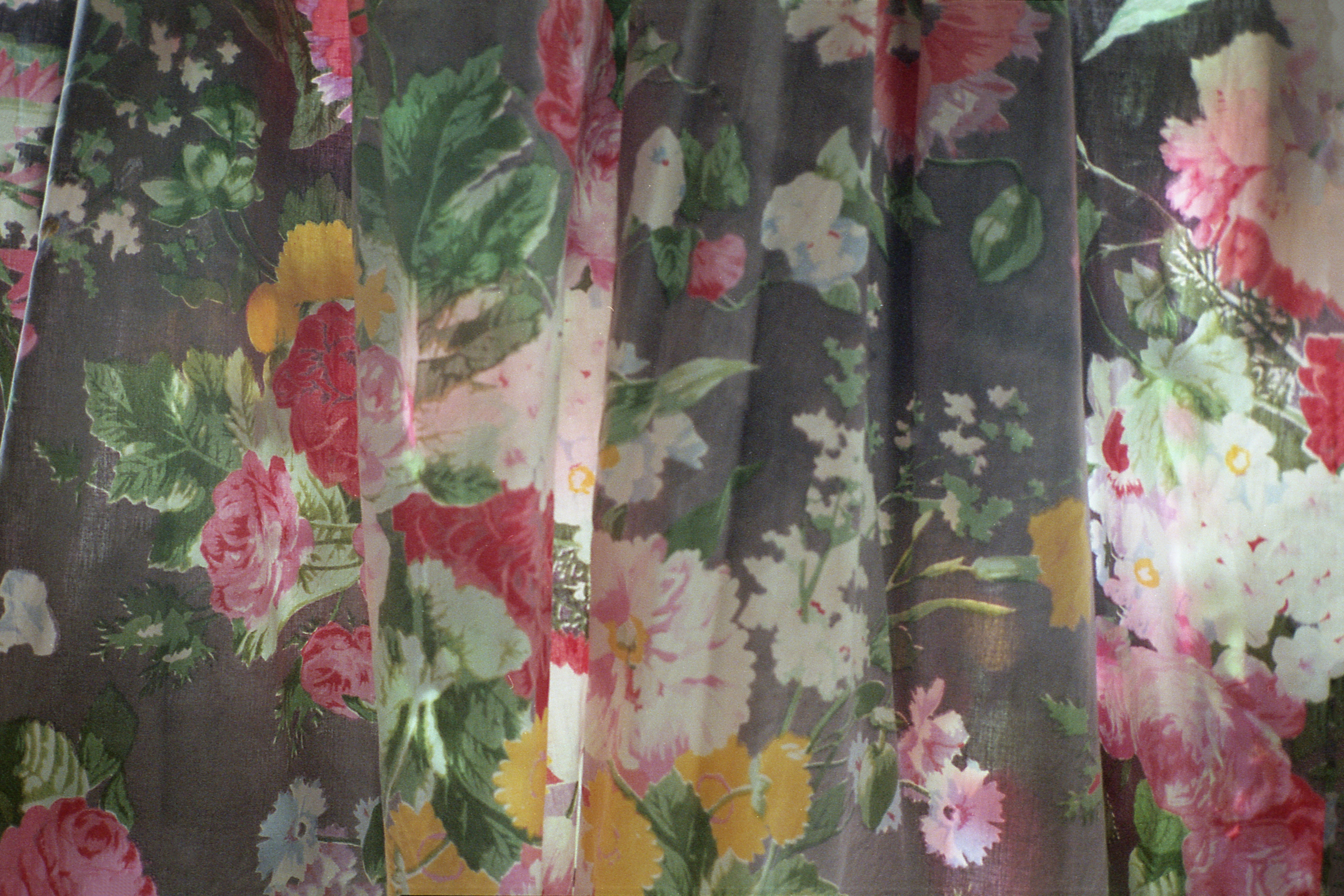
COMMISSION #20 – VALERIE GIAMPIETRO
MT #1 (Iuno), 2026, Lambda C-print, 45 x 30 cm. Courtesy dell’artista e Ermes Ermes, Roma
Some of us have always believed that clothes could speak. All too often described as expressions of taste of an era, or of a passing fashion, they hold something that goes far beyond their function. It takes only the opening of a wardrobe for a fabric, a pattern, a fold to suddenly bring back a presence, a voice, a scent, a texture: that unique and overwhelming ability to unlock memories.
In the Poetica dello Spazio Gaston Bachelard recognised wardrobes, drawers, and chests as some of the places in which a home preserves its intimacy. An interior within an interior, a space that does more than contain objects: it safeguards their secret order, the time accumulated within them. A geometry of memory, in which every hanger supports an empty form that still retains the outline of a body. An arrangement of absences, each with its own density, a persistence that also runs through matter. In this sense, fabric is never merely decorative: it’s a second skin that clings, adapts, and records the habits of the person who wore it, retaining traces of their gestures in its very texture.
It is from this dimension that Valerie Giampietro’s photographic research takes shape. Returning to her mother’s wardrobe, she finds herself immersed in a universe of fabrics, colours, patterns, and familiar objects. Behind the lens, her gaze draws so close to the garments that their original function almost disappears. She observes their folds, their overlapping layers, their transparencies, and the light that passes through them. Floral patterns merge into one another; fabrics turn into landscapes, draperies, almost sculptural volumes. As the garments lose their contours, the mother’s body begins to reclaim space, to make itself felt.
Among these folds Valerie’s IUNO emerges, in her guise as the goddess who protects familial bonds, evoked through the veil and mantle that characterise her iconography. Drapery follows the contours of the body, defines its presence in space, or merely suggests it, before concealing it altogether. A small architecture, an envelope that both protects and reveals.
What might Juno’s wardrobe have looked like, had she been free to choose for herself? What colours would she have worn, what fabrics would she have preferred? How much of her body would she have chosen to reveal, or to conceal beneath those draperies that sculptural tradition has fixed in solemn, monumental forms, while painting has often loosened them into more sensual and domestic representations? And what might the everyday life, the private world, of a goddess have looked like, when her image has been shaped over the centuries by the ways in which her body has been covered, veiled, or exposed?
In Valerie’s photographs, garments release and acquire an unfamiliar consistency, suspended between substance and apparition. From a second skin, fabric becomes an archive, a surface upon which time has left its traces. Through the artist’s gaze, these objects, so closely bound to a personal history, open onto a further dimension, giving way to shapes, colours, and matter capable of awakening other memories, other stories.
If Roland Barthes, Camera chiara recognised photography’s particular ability to attest to what has been, in Valerie Giampietro’s works this relationship seems to be doubled: the image preserves the trace of an object that, in turn, retains the trace of a body, as though attempting to bridge the distance between them. The wardrobe, like photography itself, becomes a space in which memory is not preserved unchanged, but continues to transform. Perhaps not unlike the garments of Juno, whose forms and meanings have continued to shift across the centuries, offering us a different face of the goddess each time. The fabrics remain, but what we recognise in them changes along with us.
Valerie Giampietro Valerie Giampietro (b. 1978, Rome) is an artist photographer based in Rome. Her practice explores light and natural expression through analogue photographic processes. Landscapes, faces, objects and natural elements form an intimate and spontaneous visual universe, collected over time in a personal archive. Moving between observation and collection, she brings together images and objects that become fragments of personal narratives. Her research investigates the traces of personal experience and the shifting relationship between memory and reality, exploring photography as a way of reflecting on presence and absence. Her work has been exhibited at Ermes Ermes/Lateral, Rome; Vulcana, Stromboli; Paint it Black, Turin, SOLDES, Los Angeles, alongside the artist book I’m Afraid of Flowers. (2025). I’m Afraid of Flowers (2025).