


Francesca Cornacchini’s IUNO is an archaeological artifact born from a temporal paradox. It is the attribute of a transfigured pagan deity: representing her are two large goat horns grafted onto a peaked cap—elements from different eras and contexts, combined according to a principle reminiscent of the Eternal Return, or rather, suggesting the existence of an archetypal constancy.
The horns, precariously attached with adhesive tape, are an attribute of Juno Caprotina, a deity of Etruscan origin, goddess of fertility and rebirth, guardian of every natural reproductive cycle. The cap, adorned with a crown of laurel, represents instead the indispensable accessory of raver, an emblematic figure of underground culture, always a source of inspiration for the artist. A symbol of that youthful subculture that embodies more than any other the subversive dimension of celebration, the raver becomes the contemporary equivalent of the goddess.
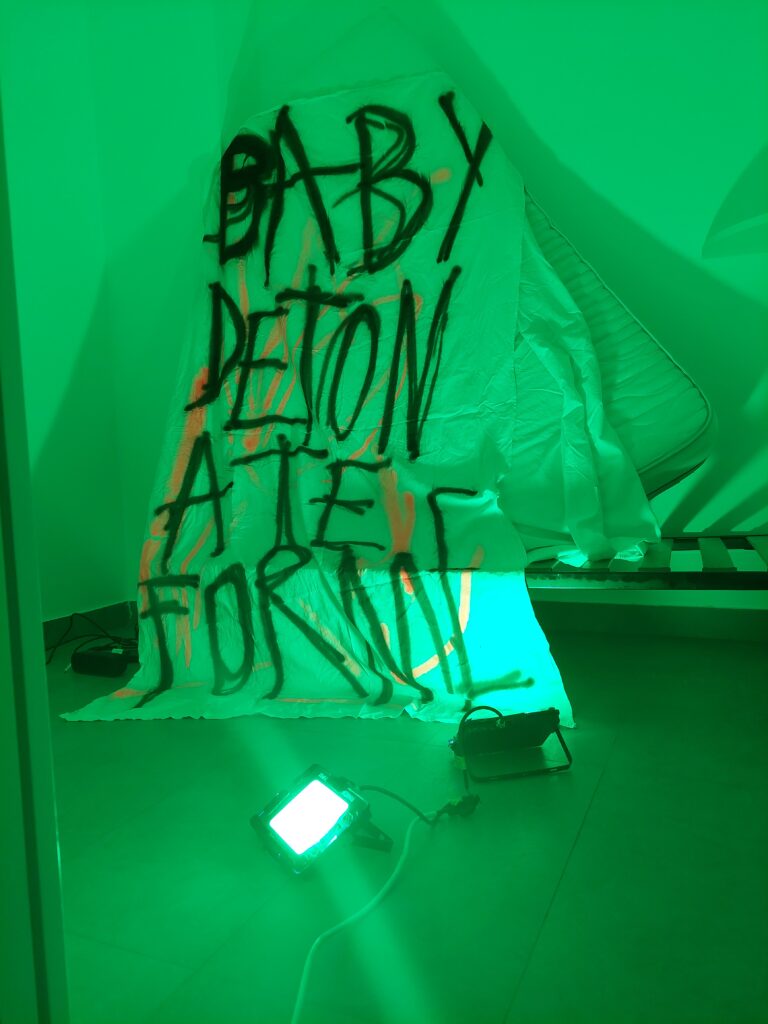
Next to the hat, placed in the IUNO lounge, is the intervention conceived by the artist for the bedroom usually used as accommodation: a green light and a speaker playing psy-trance music lead the visitor into the lair of a squatter goddess, dominated by an unmade bed on whose mattress is emblazoned the inscription "BABY DETONATE FOR ME." The phrase, like the bed, explicitly refers to the sensual and seductive character attributed to Juno Caprotina, the goddess of reproduction.
So if the IUNO lounge is configured as a canonical exhibition space, where lighting and the support of the artwork suggest the presentation of an archaeological find, the room recontextualizes the object in contemporary times.
Wearing the new headgear, Juno transforms into the priestess of a profane rite that is structured, as in ancient Nonae Caprotinae, starting from the loss of control: the syncopated rhythm of psy-trance music and the frenetic movement of the body thus correspond to the generative frenzy staged in the Roman ceremony. The dimension of the celebration becomes the space of divine intervention, a place where to indulge in mania, a delimited interval of time that ensures prosperity, harmony, and order.
Paganism and culture culture, recurring themes in Francesca Cornacchini's production, can thus be interpreted as dimensions endowed with the same subversive charge, coherent alternatives to dominant cultures.
Francesca Cornacchini, Giunone Caprotina, 2022, Installation, Beta cap, goat horns, duct tape, masking tape, Plexiglas, metal brackets, bolts
Nonae Caprotinae, 2022, Environmental Installation, Audio, acrylic spray on bedsheet, mattress, LED lights
Text by Giulia Gaibisso
Francesca Cornacchini (Rome, 1991) lives and works in Rome. After completing a three-year program in scenography and a two-year program in sculpture at RUFA – Rome University of Fine Arts, in 2018 she won the RUFA CONTEST with the work THE CODE#01 and simultaneously received the REF – Roma Europa Festival award, presenting the work at MACRO La Pelanda (Rome). In the same year, she joined the artist-run space Spazio In Situ. Her works have been exhibited in various institutional and independent spaces, including GAM – Galleria d’Arte Moderna (Rome), Una Vetrina (Rome), Galleria Alessandra Bonomo (Rome), OFF1C1NA (Rome), Shazar Gallery (Naples), Temple University Gallery (Rome), Spazio In Situ (Rome), TILT (Lausanne, CH), Pastificio Cerere (Rome), and ARTVERONA 2021, in the LAB1 section.